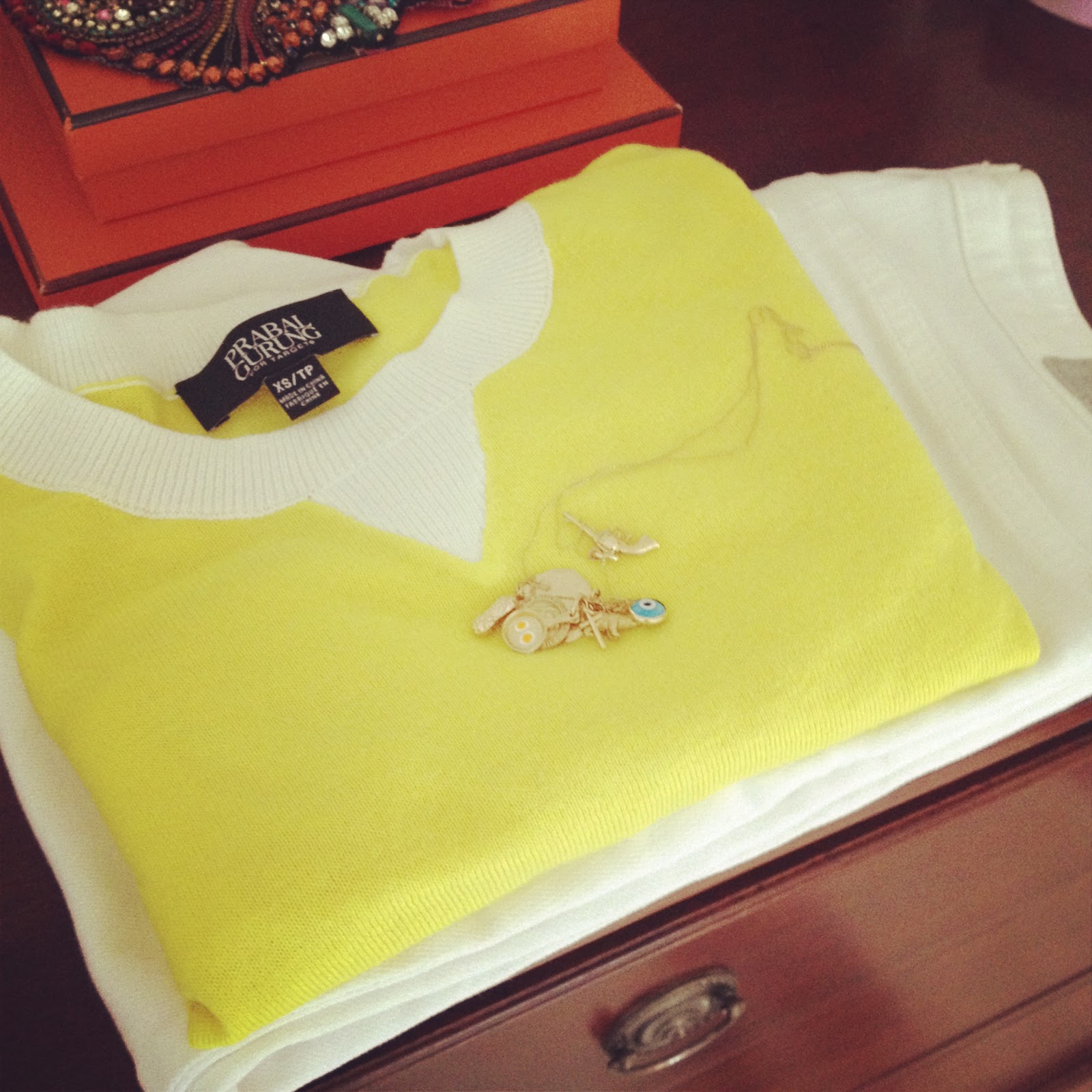
I'm into it. Arm swag is a great way to dress up an otherwise simple outfit. In my opinion - the more the merrier. Pile on everything you've got in your jewelry box and it is sure to be a conversation starter. My favorite is my cherished collection of charm bracelets. I've a bit of an addiction... Especially if they are old and unique. The most special in the bunch is my grandmother's bracelet that she built throughout the 40s and 50s. I love imagining how she felt when my grandfather gifted her with a charm that meant something special to them. I feel her energy when I wear it. It's swag with serious history.
My Charming Swag
I love the booties that represent the births of her three sons and the M1 helmet that symbolized the time they spent apart while my grandfather fought in World War II.
My Fun Swag
Just bought this swag and two mini matching swags for my girls. Excited to add it to the group.
My Gold Swag
ADMIRABLE SWAG...
Photos: Le Catch, Sincerely Jules, Vogue, Atlantic-Pacific, Keep It Chic, and Pinterest
We are on our way... Off to Mexico for a long overdue kid-free weekend. Tomorrow we head to Riviera Maya to celebrate a friend's 40th. There is something so sweet about honoring and celebrating female friends as they head into what I feel is an incredible decade. Long gone are the days of our tumultuous questioning 20s. The 30s are passed in a hazy blur of sleepless nights and new-parent exhaustion. The 40s seem like a time to reflect, appreciate, and simplify - spend time doing what you want with the people you want. I can't wait to lather myself up in sunscreen and absorb the warm sun. I can taste the salted rim and tart freshly squeezed lime juice of my first margarita. I will bob in the ocean and look up at the bright sun - wondering what my little ones are doing at home. I hope to come back refreshed but slightly groggy from long lunches with new friends and late nights having that one extra drink at the bar with my husband. That is when we allow ourselves to be silly and care-free. It's a very necessary part of being married. The silly part and the travel, just the two of us. Bags are packed and I'm off to bed...
Books, Passports, Purse - Check!
As previously noted - at least one bathing suit per day.
Some call them "Heavenly Bars" but in our house my husband lovingly refers to them as "Fat Pills". Oh the chocolatey, graham crackery goodness that awaits you with each and every bite! I contemplated not doing this post because I didn't want anyone to know how truly easy they are to make. Then I thought - "Why not share the wealth. It's much more fun getting fat with others than by yourself." Enjoy.
Ingredients:
½ cup
butter
1 ¾
cup graham cracker crumbs
¾ cup
semi-sweet chocolate chips
¾ cup
white chocolate chips
¾ cup
butterscotch chips
1 cup
chopped walnuts
1 cup
shredded coconut
1 can
sweetened condensed milk
To Make:
1)Preheat
oven to 350 degrees
2)Melt butter in microwave
3)Pour butter and graham cracker crumbs
into large bowl and mix well
4)Press graham cracker and butter
mixture into a 13x9x2 pan
5)Sprinkle chips, nuts, and coconut
evenly over graham cracker crust
6)Drizzle can of sweetened condensed
milk over pan
7)Bake for 25 minutes or until coconut
is golden brown
8) Let cool, cut into squares, and serve
Quick Tip: No need to use the cuisinart to crush graham crackers. Before opening each sleeve - hand the package over to your kids. Making cookie crumbs can be fun! Ah, who am I kidding??? Crush them yourself. It's a great way to get out aggression.
Janne Kouri goes to the gym and works hard. Almost every day he is there giving it his all. The finish line seems far away but he is prepared to fight his way there, crawling if necessary. This guy will not give up. What's on the line for him is much more serious than what most of us face every day. For Janne, the end goal is being able to walk again. Janne had an accident 7 years ago that left him paralyzed from the neck down. He and his wife, who has stood by his side since the accident, are true warriors. I challenge you to watch the video below and not believe that miracles do happen.
Watch Janne's story as it is shared on ABC
Q&A with Janne Kouri, Founder of NextStep
How did you injure your spine?
I was playing volleyball at the beach and decided to go for a swim. I ran into the water, dove through a wave, and hit my head on a sandbar. I was instantaneously paralyzed from my neck down. I broke my C5 and C6 vertebrae. Luckily a gentlemen on the beach saw me floating in the water and pulled me to safety. Shortly after I was in the hospital and the doctors told me what had happened and they said I had no hope for recovery.
What did you find when you started to look for physical therapy options?
We found that there were no good options available in California and that the only facility in the country that would allow me to have access to locomotor training, the best therapy for people with spinal cord injury (SCI) in the world today, was in Louisville, KY. This was an extremely eye opening experience and taught me a great deal about our healthcare system and the lack of options and resources for people with disabilities. We had to leave our home, my wife had to quit her job, and we had to move across the country to a place where we didn't know anyone, simply to get the rehabilitation I needed for survival. We were fortunate that I had good insurance and the financial means to do so. What were the millions of people in the US doing that did not have the financial means? That was the driving factor to starting NextStep.
Why did you start NextStep?
We started NextStep to ensure that people living with paralysis and other physical disabilities have access to the best in rehabilitation, fitness, health, and wellness within their own community for their entire life. We want to create a lifelong continuum of care for these individuals and to give them the opportunity to live long, healthy, and happy lives. There is a huge gap in our healthcare system. The average rehab hospital kicks out their patients in 36 days, then they are sent home, and they don't have access to any ongoing fitness, health, and wellness resources. Without access to these resources it is very likely that people with paralysis will suffer from life threatening secondary health consequences such as diabetes, heart disease, poor circulation and blood pressure, etc. In third world countries, paralysis is a death sentence.
Who are you hoping to help?
We are hoping to help everyone in the US and eventually globally that is living with paralysis and other physical disabilities. This is not a California problem, it is a drastic global issue.
Can you briefly explain the technology you use at your facilities?
Research indicates that individuals living with paralysis can benefit from fitness, health, and wellness programs that integrate strength and aerobic fitness training, flexibility exercises and walking practice. NextStep Fitness facilities are fully accessible, have specialized state-of-the-art equipment, and maintain higher levels of staffing with people knowledgeable in providing these interventions to individuals living with paralysis. We host an activity-based programs created specifically for individuals with physical disabilities. We offer a variety of memberships that are specifically designed for each person. Some of our programs include; locomotor training, Functional Electrical Stimulation (FES), Vibration Training, 1-on-1 training, cardiovascular exercise, range of motion, and strength training. These interventions activate the neuromuscular system below the level of lesion with the goal of retraining the nervous system to recover a specific motor task. We are staffed by athletic trainers, personal trainers and exercise physiologists, together referred to as activity-based technicians. Our technicians are trained annually by the Christopher and Dana Reeve Foundation NeuroRecovery Network's experienced facility and clinical center members.
In locomotor training sessions, the body of the member is suspended in a harness over a treadmill, while the specially trained activity-based technicians assist the member in moving his/her legs to simulate walking. Locomotor training works to “awaken” dormant nerve pathways by repetitively stimulating the muscles and nerves below the injury level. It is based on recent advances in scientific understanding about neural plasticity (the ability of the nerve cells in the nervous system to develop new connections and “learn” new functions) and the role the spinal cord plays in stepping and standing.
How did it feel to stand on your own two legs again?
Anytime I hit a milestone, it is very encouraging and uplifting. I have to take pride in small accomplishments and need to understand that it is a marathon, not a sprint. Standing is great, running will be much better.
Do you have faith that with this technology you will walk again some day?
A combination of innovative technology, great trainers, and hard work will get me walking again. I am fortunate to have access to the best equipment and staff this country has to offer, but there is no magic pill yet so I need to keep up an intensive regiment and do everything I can to ensure that I stay healthy and get stronger each day. To donate or learn more about NextStep click here.